Renting vs. Buying a Home: Running the Real Numbers
"Renting is throwing money away" might be the most repeated, least examined sentence in personal finance. Sometimes buying wins. Sometimes renting wins by six figures. The difference is never the slogan; it's the numbers, and most people have never actually run them. Let's run them.
The comparison most people get wrong
The honest rent-vs-buy comparison isn't rent versus mortgage payment. It's rent versus the full, unrecoverable cost of owning (interest, taxes, insurance, PMI, maintenance), plus what the down payment could have earned if invested instead. Equity and appreciation offset owning's costs over time, which is why the answer usually hinges on how long you stay.
Both sides have money that vanishes. A renter's vanishing money is obvious: the rent check. An owner's is hidden inside the payment and around it: interest to the bank, taxes to the county, premiums to the insurer, repairs to the house. Only the principal slice of a mortgage payment builds equity, and early on that slice is thin.
What owning actually costs: a worked example
Take a $400,000 home with 10% down ($40,000), financing $360,000 for 30 years near current rates (the 30-year average has run between about 6% and 6.7% this year; we'll use 6.5%):
| Monthly cost | Amount | Recoverable? |
|---|---|---|
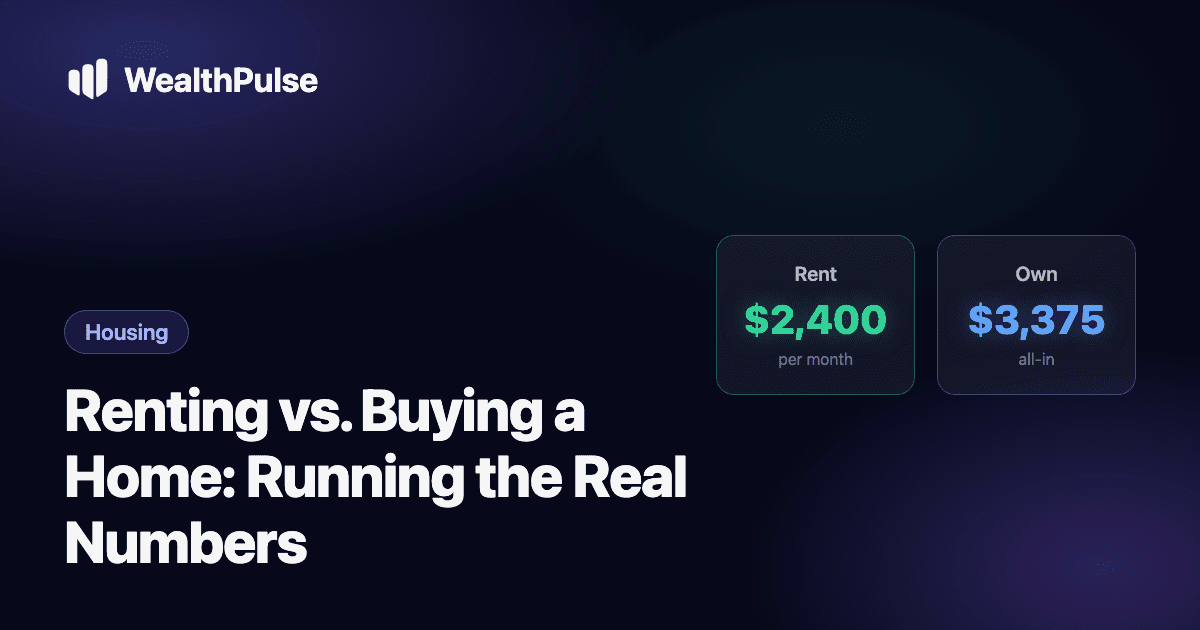
| Principal & interest | $2,275 | Only the principal part |
| Property tax (~1.1%/yr) | $367 | No |
| Homeowners insurance | $175 | No |
| PMI (under 20% down) | $225 | No |
| Maintenance (~1%/yr) | $333 | No |
| Total monthly cost | ≈ $3,375 |
Here's the part that surprises people: in year one of that loan, about $23,300 of the $27,300 in mortgage payments goes to interest. Just over $4,000 builds equity. Add the other unrecoverable lines and this "owner" spends roughly $3,040 a month on housing that builds zero wealth, at least at first. If a comparable home rents for $2,400, the renter is ahead about $640 a month on unrecoverable costs, and nearly $1,000 on raw cash flow, and if they invest the $40,000 down payment plus that monthly difference, the gap compounds.
So why does anyone buy? Because the picture inverts with time: the principal slice grows every year, rents rise while a fixed payment doesn't, PMI comes off once you request it at 20% equity (or automatically at 22%), appreciation accrues on the whole home's value (leverage working for you), and after decades you own an asset outright. Ownership is a long game with an expensive opening.
The 5-year rule (and why it exists)
Buying and selling are brutally expensive: closing costs going in, agent commissions and fees going out, often totaling 10% to 15% of the home's value round trip. On our $400,000 example that's potentially $40,000 to $60,000 in pure friction. Since early payments barely touch principal, a two- or three-year stay frequently loses money even in a rising market. Hence the rule of thumb: don't buy unless you reasonably expect to stay five-plus years. Career flexibility, relationship stage, and city certainty are financial inputs here, not side notes.
A 60-second market test: the price-to-rent ratio
Divide the price of a home by the annual rent of a comparable one. A $400,000 house that rents for $2,400 a month ($28,800 a year) has a ratio of about 14. Rough guide: under 15, buying looks favorable; 16 to 20, renting usually has a modest edge; over 20, renting usually wins the pure math and buying becomes a lifestyle decision that costs a premium. Ratios vary wildly by city, which is why the same salary can face an easy call in one metro and the opposite call two states over.
When each side tends to win
Renting tends to win when: you may move within five years, the local price-to-rent ratio runs high, your emergency fund or down payment would be wiped out by buying, or you'd become "house poor," with a payment so large it crowds out retirement contributions and the rest of your plan. A renter who actually invests the difference is not behind; they're building wealth in a different account.
Buying tends to win when: you'll stay long, the ratio is low, your income is stable, and the total payment (the full $3,400 version, not the teaser $2,300 version) fits inside a budget that still funds everything else. Fixed principal-and-interest is also inflation insurance: the payment that feels heavy in year one often feels light in year ten while renters absorb a decade of increases.
Run it on your own numbers
The framework only matters applied to your life. Three steps: price the full ownership cost for homes you'd actually buy (our table is the template); compare against comparable rents, not your current below-market lease; and check what the payment does to the rest of your budget, because a house that ends your retirement contributions is expensive at any price. If you're saving toward the down payment, give it a named target in Goals and watch it fill; and remember a home is one line on a balance sheet, not the whole thing. Your net worth counts the house and the mortgage together (equity is what's left), which keeps the purchase honest in the bigger picture; here's how to read that statement. For the judgment call itself, WealthPulse's AI analysis can pressure-test your rent-vs-buy math against your real cash flow.
The bottom line
Neither renting nor buying is virtuous; they're two prices for the same shelter with different shapes over time. Renting buys flexibility and frees capital to invest. Buying front-loads costs to purchase a fixed payment and forced equity. Run the full ownership cost, apply the five-year test, check the price-to-rent ratio in your actual market, and choose the door that leaves the rest of your financial plan intact. That's not settling. That's the math.
Stress-test the biggest purchase of your life. WealthPulse shows what a mortgage does to your budget, tracks your down payment goal, and keeps your whole net worth in view while you decide.
Start your free 7-day trial →Frequently asked questions
Is it cheaper to rent or buy right now?
In most US metros, the monthly cost of renting a comparable home is currently lower than the full cost of owning it, once you count taxes, insurance, maintenance, and mortgage interest near 6.5%. Buying tends to win over longer horizons through equity and fixed payments, so the answer depends heavily on how long you'll stay and your local price-to-rent ratio.
What is the 5-year rule for buying a house?
The rule of thumb says don't buy unless you expect to stay at least five years. Transaction costs (closing costs when buying, agent commissions and fees when selling) can total 10% to 15% of the home's value round-trip, and early mortgage payments are mostly interest, so short stays frequently lose money even in rising markets.
What hidden costs come with owning a home?
Beyond principal and interest: property taxes, homeowners insurance, PMI if you put down less than 20%, maintenance and repairs (commonly estimated at 1% to 2% of home value per year), possible HOA dues, and higher utility costs. These often add 40% or more on top of the base mortgage payment.
Is renting throwing money away?
No. Rent buys housing, the same way interest, taxes, insurance, and maintenance buy housing for an owner; none of those build equity either. In year one of a typical 30-year mortgage at current rates, the large majority of your payments go to interest, not principal. The real comparison is total unrecoverable costs on each side, plus what a renter earns by investing the down payment they didn't spend.
What is a good price-to-rent ratio?
Divide a home's price by the annual rent of a comparable place. Under roughly 15, buying looks favorable; 16 to 20 usually gives renting a modest edge; above 20, renting is often the better financial deal and the case for buying rests more on lifestyle and long tenure.
This article is general educational information, not financial or real estate advice. The worked example uses illustrative figures (6.5% rate, 1.1% property tax, 1% maintenance); your market and loan terms will differ, and mortgage rates change constantly. For guidance specific to your situation, consult qualified professionals.
Take control of your money
Budgeting, investing, and AI analysis in one dashboard. 7-day free trial.
Start 7-day free trial →