The Truth About Credit Card Minimum Payments
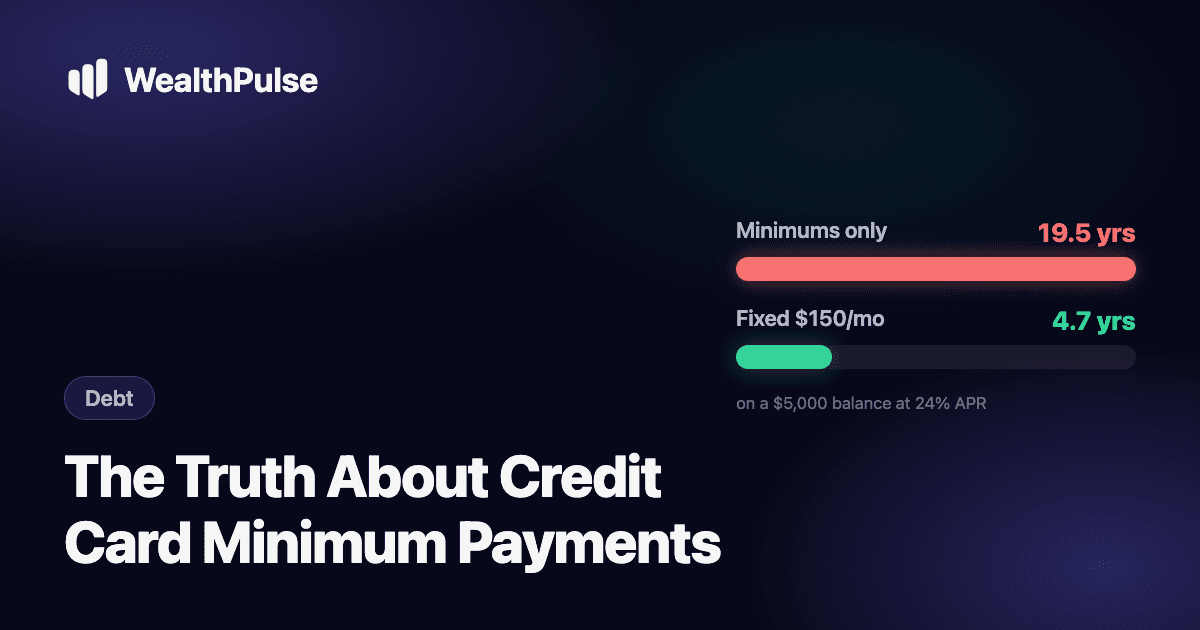
The minimum payment on your statement looks like a helpful suggestion. It's actually a precisely engineered number: large enough to keep the account current, small enough to keep the balance alive for decades. Here's the formula, the math on what "just the minimum" really costs, and the counter-moves.
How minimum payments are calculated
Most credit card minimum payments are the greater of a flat floor (most commonly $40) or a formula of roughly 1% of your balance plus that month's interest and fees. The design means your required payment barely exceeds the interest charge, so only a sliver touches the actual debt each month.
Look at one month concretely. On a $5,000 balance at 24% APR, a month's interest is about $100. A "1% plus interest" minimum is roughly $150. So of your $150 payment, $100 evaporates as interest and $50 reduces the debt. You paid 3% of the balance; you erased 1%.
The 19-year credit card: what minimums actually cost
Run that structure to completion and the numbers get dark. Same $5,000 at 24% APR, paying exactly the minimum every month as it slowly shrinks:
| Strategy | Time to zero | Total interest |
|---|---|---|
| Minimum payments only | ~19.5 years | ~$8,890 |
| Fixed $150/month | 4.7 years | ~$3,320 |
| Fixed $250/month | 2.2 years | ~$1,450 |
Read the first row again: nearly two decades, and almost $8,900 of interest on a $5,000 purchase. The debt costs more than the thing it bought. And notice what the second row reveals: the escape doesn't require heroics. The minimum starts around $150; simply refusing to let your payment shrink as the required minimum drops cuts twenty years to under five. That's the whole trick the formula plays: it lowers your payment as the balance falls, and hopes you follow it down.
This isn't hidden, exactly. Since the CARD Act of 2009, every statement on an account carrying a balance includes a Minimum Payment Warning box showing your card's version of this math. It may be the most ignored table in finance. Find it on your next statement; it's clarifying.
Why minimums exist (and what they're actually for)
To be fair to the number: the minimum has a legitimate job. Paying it on time keeps the account current, which protects your payment history, the single largest factor in your credit score. A missed payment can cost tens of points, more if your file is clean, and lingers for years; an on-time minimum prevents all of that. So in a genuinely tight month, the minimum is the right defensive move.
The trap isn't paying the minimum once. The trap is paying it by default, month after month, while the balance quietly holds your utilization high (the second-largest scoring factor) and the interest compounds. The minimum is a floor for emergencies that gets marketed as a plan.
The escape plan, in order
1. Freeze your payment; never follow the minimum down. Whatever you can pay this month, automate that flat amount permanently. This single decision, requiring zero extra dollars over time, is worth years and thousands in the table above.
2. Find the extra $50 to $100. The gap between 19 years and 5 is often one subscription audit wide. Comb your recurring charges (a subscription tracker surfaces them in minutes) and let your budget name a fixed attack number it can actually sustain.
3. Multiple cards? Pick an order and roll payments. Highest rate first saves the most interest; smallest balance first builds momentum. We compared both with real simulations in avalanche vs. snowball; either beats unfocused minimums by thousands.
4. Consider a 0% balance transfer if your credit allows. Six to 21 months where every dollar hits principal changes the math dramatically. Mind the 3% to 5% transfer fee and the post-promo rate, and don't refill the old card.
5. Give the debt a death date. Vague debt lasts; scheduled debt dies. A debt tracker turns your balances, rates, and payment into an actual payoff date and running interest-saved total, which is the difference between "paying on my card" and "debt-free in March 2029."
The bottom line
The minimum payment is a well-designed product, just not designed for you. Use it for what it's for: keeping the account current in a hard month. Then beat it the boring way: a frozen, automated payment above the minimum, an order of attack, and a visible payoff date. The difference on one mid-size balance is measured in decades and thousands of dollars, and it starts with refusing to let your payment shrink.
Give every balance a payoff date. The WealthPulse Debt Tracker turns your cards into a plan: avalanche or snowball, projected payoff date, and interest saved, tracked next to your budget.
Start your free 7-day trial →Frequently asked questions
How is a credit card minimum payment calculated?
Most issuers charge either a flat floor (most commonly $40) or a formula: roughly 1% of your balance plus that month's interest and fees, whichever is greater. The formula is engineered so the payment barely outruns the interest, which is why balances shrink so slowly on minimums.
What happens if I only pay the minimum on my credit card?
The balance shrinks extremely slowly while interest compounds on what remains. A $5,000 balance at 24% APR on typical minimums takes roughly 19 years to pay off and costs nearly $8,900 in interest, more than the original debt. Your statement's Minimum Payment Warning box shows your card's exact version of this math.
Does paying the minimum hurt my credit score?
Paying the minimum on time protects your payment history, the biggest scoring factor, so it doesn't hurt the way a missed payment does. But the balance it leaves behind keeps your utilization high, which is the second-biggest factor. On-time minimums prevent damage; they don't build progress.
Why do minimum payments decrease over time?
Because most formulas are a percentage of the balance, the required payment falls as the balance falls. If you pay only the shrinking minimum, your payoff stretches even longer. The fix: freeze your payment at the original amount (or higher) even as the required minimum drops.
How do I get out of minimum-payment debt fastest?
Fix your payment at a flat amount above the minimum and never let it shrink; even $150/month instead of minimums cuts a $5,000, 24% APR payoff from about 19 years to under 5. Then pick an order (avalanche or snowball) for multiple cards, and consider a 0% balance transfer if you qualify, minding the 3% to 5% fee.
This article is general educational information, not financial advice. The payoff figures are simulations assuming a fixed 24% APR and a "1% of balance plus interest, $25 floor" minimum formula (a low floor; cards using today's more common $40 floor pay off faster); your issuer's formula and rate will differ, and your statement's Minimum Payment Warning shows your exact numbers. For guidance specific to your situation, consult a qualified financial professional.
Take control of your money
Budgeting, investing, and AI analysis in one dashboard. 7-day free trial.
Start 7-day free trial →