Debt Avalanche vs. Snowball: Which Payoff Method Wins?
Personal finance has been arguing about this for twenty years. One camp says pay the highest interest rate first, because math. The other says pay the smallest balance first, because humans. We ran the actual numbers on the same set of debts, and the honest answer is more useful than either camp admits.
The two methods in one minute
The debt avalanche pays extra toward your highest-interest-rate debt first, minimizing total interest paid. The debt snowball pays extra toward your smallest balance first, producing quick wins that keep you motivated. In both, you pay every other debt's minimum on time, and when a debt dies, its entire payment rolls into the next target, so your total monthly attack never shrinks.
That rollover is the engine of both methods, and it is non-negotiable either way: missed minimums trigger fees and credit damage that swamp any strategy. The only question the two methods answer differently is which debt gets the extra money first. Everything else, the discipline, the rollover, the fixed monthly total, is identical.
The same four debts, both ways: a real comparison
Meet a household with $29,500 of debt and $1,000 a month to throw at it ($705 in minimums plus $295 extra):
| Debt | Balance | APR | Minimum |
| Credit card highest rate | $8,500 | 24% | $215 |
| Car loan | $12,000 | 7% | $285 |
| Student loan | $6,000 | 5.5% | $115 |
| Personal loan smallest | $3,000 | 10% | $90 |
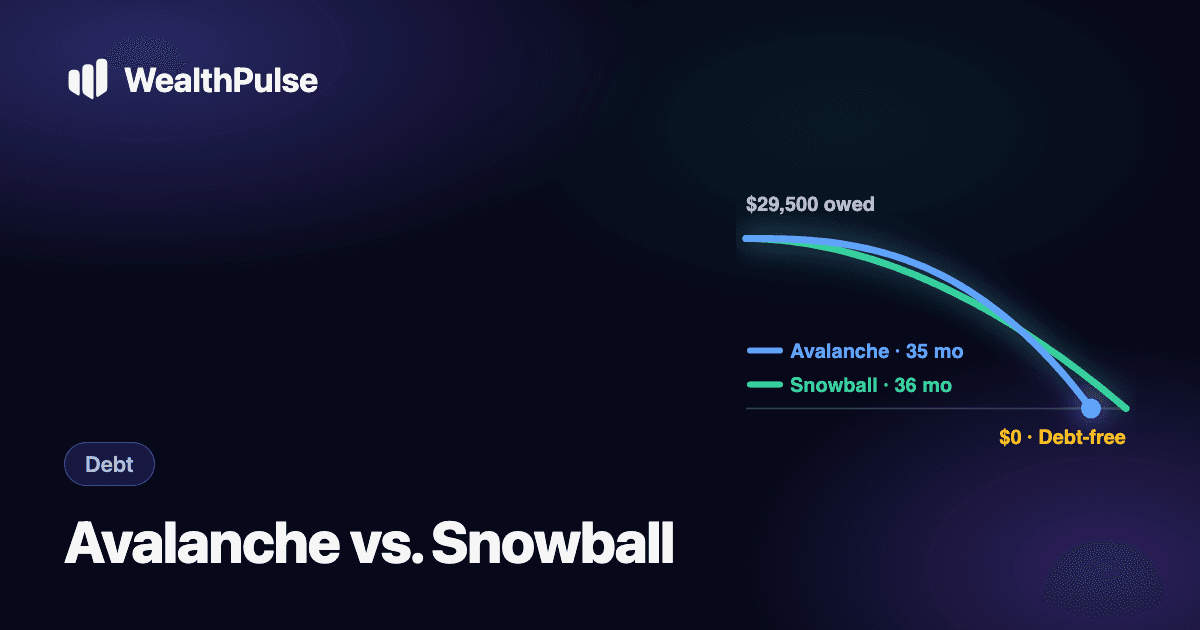
The avalanche attacks the credit card (24%) first. The snowball attacks the personal loan ($3,000) first. Same debts, same $1,000 every month, simulated to the last payment:
Read the two numbers that matter. The avalanche saves $1,637 in interest and finishes a month sooner, a real, keep-it-in-your-pocket win. But look at the first milestone: the avalanche's first paid-off debt doesn't arrive until month 21. That's nearly two years of grinding at an $8,500 card with nothing to show but a slowly shrinking number. The snowball kills its first debt at month 9 and its second by month 19, two accounts closed and two payments freed before the avalanche has closed one.
For context: paying minimums only, this household would be in debt for 57 months and pay $10,269 in interest. Either method beats doing neither by a mile. The $1,637 gap between them is small next to the $4,000 to $6,000 either saves from just paying minimums.
There's a second reason to care about the order beyond interest. That 24% card is almost certainly the debt dragging on your credit utilization, which is the second-largest input in how your credit score is calculated. Killing a revolving balance moves your score in a way that retiring an installment loan simply doesn't.
What the research actually says
The math side is settled: the avalanche always pays at least as little interest as any other order, and an empirical analysis of thousands of households in the Fed's Survey of Consumer Finances confirmed it wins in most real situations. If humans were spreadsheets, the debate would be over.
But the behavioral evidence is just as consistent, and it points the other way. Research covered by Harvard Business Review and published in the Journal of Marketing Research found that people who concentrate their payments and close out individual accounts early are more likely to actually finish paying off their debt. Progress you can feel, an account at zero, a statement that stops coming, is fuel, and the snowball is engineered to deliver it as early as possible.
And here's the nuance both camps skip: the size of the avalanche's advantage depends entirely on how spread out your rates are. Industry analyses that ran both methods across realistic debt loads found the gap ranges from four figures down to almost nothing. In one average-household scenario, the two methods differed by just $29. When your rates cluster together, the orders converge and the math argument nearly disappears. When one debt is a 24% card and the rest are single-digit loans, like our example, the avalanche's edge is real money.
So which should you choose?
Pick the avalanche if your rates are far apart (a 20%+ card next to single-digit loans), the interest gap for your debts runs to four figures, and a spreadsheet trend line is motivation enough. You're paying for optimality with patience.
Pick the snowball if you have several small debts you could clear within months, you've started payoff plans before and stalled, or the number of separate payments is itself the stress. You're paying a modest interest premium for a finished plan, and a finished plan beats an optimal abandoned one every time.
Or steal from both. The hybrid that works for many people: snowball your first one or two small debts for the early win, then switch to avalanche for the expensive remainder. And send windfalls, tax refunds and bonuses, at the highest rate regardless of your method. Your plan isn't a contract; it's allowed to evolve.
One more honest note: before locking in either order, check whether the problem can be shrunk directly. A 0% balance transfer (typically 12 to 21 months) or a consolidation loan below your average rate cuts interest no matter which order you choose. Mind the transfer fees and the post-promo rate, then run your method on what's left.
Where the extra payment actually comes from
Both methods assume you have extra money to send. If you don't yet, that's the real first step, and it's a budgeting problem rather than a payoff-order problem. The 50/30/20 rule is a fast way to size it: the 20% earmarked for savings and debt payoff is precisely the bucket your extra payment lives in. Even $150 a month of found money reshapes every timeline above.
Run both methods on your actual debts
Everything above is one example household. Your answer depends on your balances, your rates, and your spare monthly dollars, so run the comparison on your real numbers before committing.
That's exactly what the WealthPulse Debt Tracker does: enter your debts once, and it builds both the avalanche and snowball plans side by side, your payoff date and total interest under each, so the "$1,637 question" gets answered with your numbers instead of ours. Pick a method and it tracks every balance as it falls.
The extra payment is the other half of the machine, because the method only orders the money. The Budget Planner finds it, showing what's actually left after essentials each month. If the honest answer is "nothing's left," the Subscription Tracker is the fastest place to manufacture an extra payment, since forgotten recurring charges are the closest thing to free money, and the Transaction Log shows where the rest went. Set the payoff date as a milestone in Goals, and watch the whole effort surface where it ultimately counts: the liabilities side of your Net Worth Tracker, shrinking month after month. Reading that shrinking liability column is its own signal, and it's one of the five things worth watching on your net worth statement.
The bottom line
The avalanche wins the math, always has and always will. The snowball wins the psychology, and the research says psychology is what decides whether you finish. So the real answer isn't a method; it's a match. Rates far apart and patience to spare? Avalanche. Need the early wins to stay in the game? Snowball, and don't apologize for the premium. Either way, the household in our example beats the minimum-payment path by four to six thousand dollars. The only losing move is not picking one.
See your payoff date under both methods. The WealthPulse Debt Tracker builds your avalanche and snowball plans side by side, payoff date, interest saved, and every balance tracked, next to your budget, goals, and net worth.
Start your free 7-day trial →Frequently asked questions
What is the debt avalanche method?
With the debt avalanche, you make minimum payments on every debt and put every extra dollar toward the debt with the highest interest rate. When it's gone, you roll that entire payment into the next-highest rate. It minimizes the total interest you pay and is the mathematically optimal order.
What is the debt snowball method?
With the debt snowball, you make minimum payments on every debt and put every extra dollar toward the smallest balance, regardless of interest rate. When it's gone, you roll its payment into the next-smallest debt. You pay somewhat more interest, but you get your first win much sooner, which is why many people stick with it.
Which saves more money, avalanche or snowball?
The avalanche always saves at least as much interest as the snowball, because it attacks the most expensive debt first. How much more depends on your rates: with one high-APR card and several low-rate loans the gap can be thousands of dollars, but when your rates are similar the difference can shrink to almost nothing.
Why do more people finish the snowball method?
Behavioral research, including studies covered by Harvard Business Review and work in the Journal of Marketing Research, finds that people who concentrate payments and close out accounts early are more likely to finish paying off their debt. Quick, visible wins sustain motivation, and the snowball is engineered to deliver them first.
Can I switch between snowball and avalanche?
Yes, your payoff plan isn't a contract. A popular hybrid starts with the snowball to clear one or two small debts for momentum, then switches to the avalanche so the remaining high-rate balances cost as little as possible. Switching keeps both the psychology and most of the math.
Do balance transfers work with these methods?
Yes, and they stack with either one. A 0% balance transfer (typically 12 to 21 months) or a consolidation loan at a lower rate reduces the interest side of the problem directly; you then apply avalanche or snowball ordering to whatever debts remain. Just mind transfer fees and the rate after the promo period ends.
This article is general educational information, not financial advice. The worked example assumes fixed interest rates and minimum payments for illustration; real credit card minimums typically decline with the balance, which changes exact figures. All analysis is for informational purposes only. For guidance specific to your situation, consider speaking with a qualified financial professional.
Take control of your money
Budgeting, investing, and AI analysis in one dashboard. 7-day free trial.
Start 7-day free trial →