Should You Pay Off Debt or Invest First? A Framework
Every extra dollar you earn faces the same fork: kill debt or build wealth. Ask the internet and you'll get religion from both camps. The actual answer is a comparison of two numbers, plus a couple of exceptions where the math is so lopsided there's nothing to debate. Here's the framework.
The core idea: paying off debt IS a return
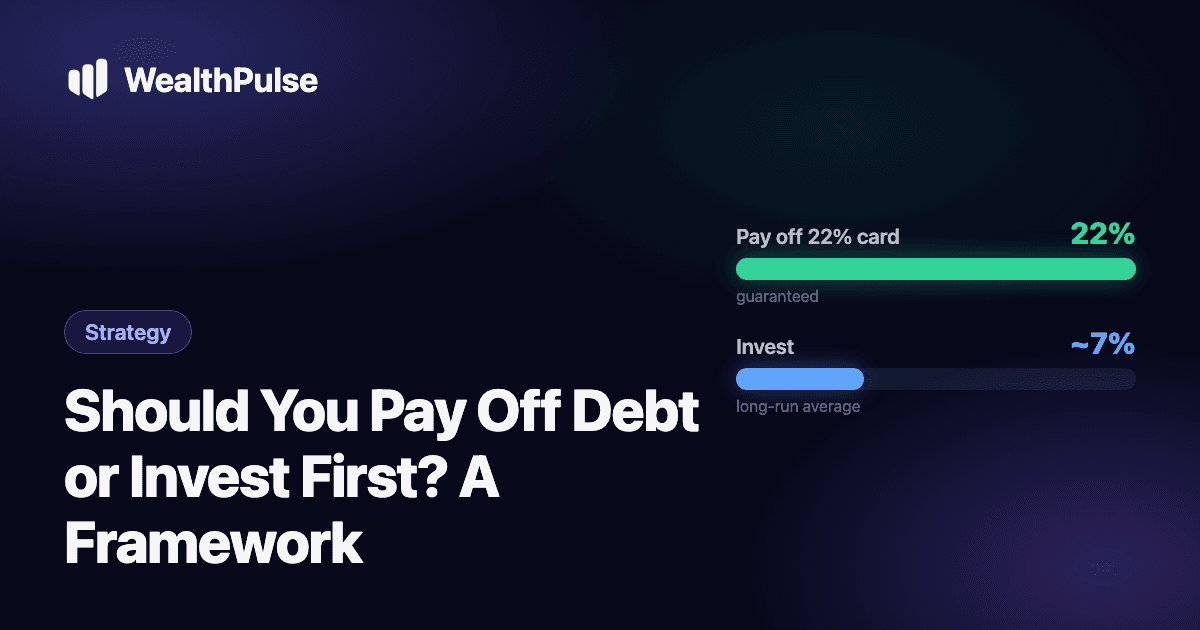
Paying off a debt earns you its interest rate, guaranteed. Erase a 22% APR credit card balance and you've "earned" a risk-free 22% on that money, because that's interest you'll never pay. The debt-vs-invest decision is just that guaranteed return versus a realistic (and uncertain) investment return, roughly 7% a year long-term for a diversified portfolio, before inflation and taxes.
Once you see it that way, most of the argument dissolves. Nobody would turn down a guaranteed 22% to chase a hoped-for 7%. And almost nobody should give up a likely 7% to prepay a 3.5% mortgage. The debate only genuinely lives in the middle band.
The rate ladder: where your extra dollar goes
| Debt interest rate | Verdict | Why |
|---|---|---|
| 20%+ (credit cards) | Pay off, aggressively | Guaranteed return no market matches |
| 8–15% (personal loans, some auto) | Pay off first, usually | Beats realistic returns with zero risk |
| 5–8% (many auto & undergraduate student loans) | Gray zone; split is fine | Close call; taxes and temperament decide |
| 0–5% (most existing mortgages, older student loans) | Invest, pay minimums | Markets have historically beaten this cost |
Two adjustments sharpen the ladder. Taxes: dollars in a 401(k) or IRA get deductions or tax-free growth, which effectively raises investing's return, while deductible interest (some mortgage and student loan interest) lowers a debt's true cost. Risk: the payoff return is certain, the market's is not, so if two options tie on paper, the guaranteed one is winning. That certainty is also why "pay it off" keeps beating spreadsheets in real life: a paid-off debt can't have a bad year.
Two exceptions that outrank the ladder
The 401(k) match comes before everything. A typical match is an instant 50% to 100% return on your contribution, which outruns even credit card APRs, and unclaimed match dollars vanish forever. Contribute to the full match even while attacking a 24% card; here's how the match works if yours is a mystery.
A starter emergency fund comes before extra payoff. Every extra dollar sent to a card is gone; if the transmission dies next month with no cushion, the emergency goes right back on the card at 24%, undoing the progress. One month of expenses in savings first, then aggressive payoff, then build the full three-to-six-month fund.
Putting it together: the order that works
For most people, the sequence looks like this: minimum payments on everything, always (a missed payment costs more than any optimization; see the truth about minimum payments). Then the full employer match. Then a starter emergency cushion. Then kill everything above roughly 8%, highest rate first or smallest balance first (we simulated both). Then the gray zone gets a judgment call or a split. Then, with only cheap debt left, invest the rest and let the mortgage run its schedule.
The split deserves a defense, because purists hate it: sending 50% of extra dollars to a 6% loan and 50% to index funds is mathematically "suboptimal" by a hair and behaviorally excellent. You watch debt fall and wealth rise in the same month, which keeps people executing the plan, and an executed decent plan beats an abandoned perfect one.
Make it concrete with your own numbers
The framework needs three inputs from your actual life: every debt's balance and APR (your debt tracker lines them up and shows what each payoff order saves in real dollars), your true monthly surplus (what your budget says is actually free, not what feels free), and your current investments (the investment tracker shows what your money is doing on the other side of the ledger). Then watch the one number that reflects both choices at once: whether you pay debt or invest, your net worth rises either way, one by shrinking liabilities, the other by growing assets. Set the milestone in Goals, and the debate becomes a dashboard.
The bottom line
Match first, cushion second, expensive debt third, invest the rest. Compare every debt's rate to a realistic 7%, remember the payoff return is the only guaranteed one, and give yourself permission to split the gray zone. Both camps are right about half the ladder; the framework is just knowing which half you're standing on.
Debt on one side, investments on the other, one score. WealthPulse tracks your payoff plan, portfolio, and net worth together, so every extra dollar's job is obvious.
Start your free 7-day trial →Frequently asked questions
Should I pay off debt or invest first?
Compare your debt's interest rate to a realistic investment return (roughly 7% long-term for a diversified portfolio, before taxes). Debt above that rate, like credit cards at 20%+, is a guaranteed high return when paid off, so attack it first. Debt well below it, like an older 3-4% mortgage, usually loses to investing. Capture any 401(k) employer match before either, since it's an instant 50% to 100% return.
Why does paying off debt count as a return?
Every dollar of interest you avoid is a dollar kept, with zero risk. Paying off a 22% APR card is economically equivalent to earning a guaranteed 22% on that money, a return no legitimate investment can promise. That's why high-interest payoff beats the market on both math and certainty.
Should I invest while paying off low-interest debt?
Usually yes. With debt in the roughly 0% to 5% range (many mortgages, some auto and student loans), long-run market returns have historically exceeded the interest cost, and tax-advantaged accounts have annual limits you can't reclaim later. Many people split: minimums plus modest extra on the debt, with the rest invested.
What about debt between 5% and 8% interest?
That's the genuine gray zone, where expected market returns and the guaranteed payoff return are close. The tiebreakers are personal: risk tolerance (the payoff is guaranteed, the market isn't), taxes (retirement account benefits favor investing; deductible interest lowers debt's true cost), and psychology. A 50/50 split of extra dollars is a defensible answer.
Should I pause 401(k) contributions to pay off debt?
Almost never below the employer match. The match is an instant 50% to 100% return, which beats even credit card interest rates, and match dollars you skip are gone forever. Contribute to the full match, then point extra dollars at high-interest debt.
This article is general educational information, not financial or investment advice. The 7% figure is a long-run historical average for illustration; future returns are not guaranteed and may include losses. Tax treatment varies by account type and situation. For guidance specific to your circumstances, consult a qualified financial professional.
Take control of your money
Budgeting, investing, and AI analysis in one dashboard. 7-day free trial.
Start 7-day free trial →